VI
 EN











QCVN 01:2017/BCT (Amendment 01:2026): National Technical Regulation on Conformity Requirements for Textile and Apparel Products
Table Of Contents
Table Of Contents
QCVN 01:2017/BCT stipulates the limit values for formaldehyde content and aromatic amines derived from azo dyes in textile products prior to their circulation in the Vietnamese market. Organizations and individuals manufacturing, importing, or trading products within the regulated scope must conduct testing, obtain conformity certification, register their declaration of conformity, affix the CR mark, and label their products according to current regulations.
Effective July 1, 2026, this technical regulation applies in conjunction with Amendment 01:2026 of QCVN 01:2017/BCT, promulgated under Circular 37/2026/TT-BCT. The Ministry of Industry and Trade (MOIT) has also issued the Consolidated Document No. 63/VBHN-TT-BCT on July 7, 2026, to facilitate referencing and compliance.
Scope of Application for QCVN 01:2017/BCT
The technical regulation applies to:
- Organizations and individuals manufacturing textile products.
- Enterprises importing textile products.
- Organizations and individuals trading and distributing these products.
- State management agencies and other relevant stakeholders.
From July 1, 2026, enterprises must cross-reference product descriptions and HS codes against Circular 33/2026/TT-BCT on the List of medium-risk and high-risk goods under the management of the MOIT to determine whether their products are subject to mandatory conformity certification and conformity declaration.
Key Requirements of QCVN 01:2017/BCT
Limits for Formaldehyde and Aromatic Amines in Textile Products
|
Textile Product Group |
Maximum Formaldehyde Limit (mg/kg) |
Maximum Aromatic Amines Limit (mg/kg) |
|
Textile products for children under 36 months of age |
30 |
30 |
|
Textile products in direct contact with the skin |
75 |
30 |
|
Textile products not in direct contact with the skin |
300 |
30 |
Testing Methods under QCVN 01:2017/BCT
|
Formaldehyde and Aromatic Amines Content |
Determined According to Standards |
|
Formaldehyde content in textile products |
TCVN 7421-1:2013 |
|
ISO 14184-1:2011 |
|
|
Aromatic amines content derived from azo dyes in textile products |
ISO 24362-1:2014 |
|
ISO 24362-3:2014 |
|
|
EN 14362-1:2012 |
|
|
EN 14362-3:2012 |
Provisions for Eco-labeled Products
Products holding an eco-label certificate listed within the regulation may be exempt from formaldehyde and aromatic amine sampling and testing.
This recognized list includes programs such as OEKO-TEX Standard 100, EU Ecolabel, Nordic Swan Ecolabel, Japan Eco Mark, and other acknowledged labels. The certificate must clearly display comprehensive information regarding the manufacturer, product, material composition, and the issuing certification body.
Being exempt from testing does not equate to an exemption from the declaration of conformity. Enterprises must still utilize the appropriate certificate to complete their dossier and fulfill the conformity declaration procedures.
Products Excluded from the Scope of QCVN 01:2017/BCT
- Baggage of arriving passengers; movable assets of organizations and individuals within duty-free quotas.
- Goods of diplomatic organizations, individuals, and international organizations within duty-free quotas.
- Gifts and donations within duty-free quotas.
- Goods exchanged by border residents within duty-free quotas.
- Sample goods for advertising with no usage value; goods for scientific research and production research.
- Goods temporarily imported for display and introduction at trade fairs and exhibitions; temporary import-re-export goods; transit, transshipment goods; goods placed in bonded warehouses.
- Unbleached or undyed fabrics and textile products.
Regulations on Affixing the Conformity Mark
The use of the conformity mark must comply with Clause 2, Article 4 of Circular No. 14/2026/TT-BKHCN.
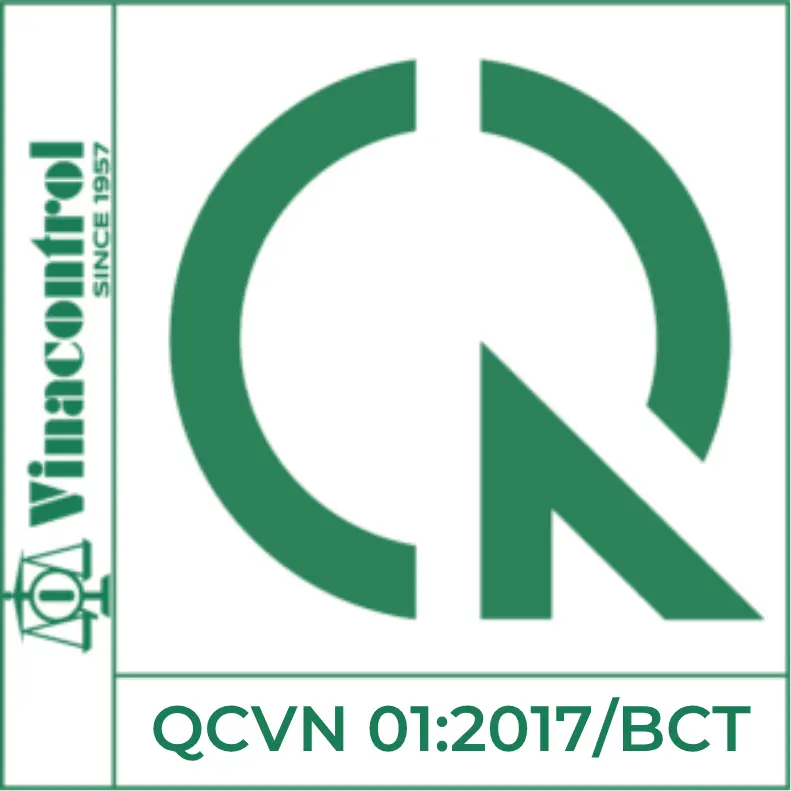
Vinacontrol's CR Mark - Conformity for Textile Products
Textile Conformity Certification Process under QCVN 01:2017/BCT
Established in 1957, Vinacontrol is the longest-standing conformity assessment body in Vietnam, designated by the MOIT to conduct conformity certification for textile products in accordance with QCVN 01:2017/BCT.
For Domestically Manufactured Textile Products
Domestically produced goods are certified under Method 5. The procedure includes:
- Step 1: Submit a certification registration form using Vinacontrol's template.
- Step 2: Proceed with contract signing and quotation.
- Step 3: Consult on establishing a Quality Management System at the factory (this step is bypassed if an ISO 9001 certificate is already held).
- Step 4: Vinacontrol conducts a factory audit and performs product sampling.
- Step 5: Review the assessment dossier.
- Step 6: Vinacontrol issues the Certificate of Conformity.
- Step 7: The enterprise declares conformity at the Department of Industry and Trade (DOIT) (Vinacontrol will guide clients through this step).
For Imported Textile Products
Imported products require import quality inspection (also known as conformity certification under Method 7). The procedure includes:
- Step 1: Submit a certification registration form using Vinacontrol's template.
- Step 2: The importing enterprise registers quality inspection procedures with Customs (for the imported consignment).
- Step 3: Vinacontrol conducts an assessment and draws samples from the consignment (sampling can occur at the port or warehouse).
- Step 4: Vinacontrol issues the Certificate of Conformity for the consignment.
- Step 5: The enterprise declares conformity pursuant to Decree 37/2026/ND-CP (Vinacontrol will guide clients through this step).
Declaration of Conformity for Textile Products under QCVN 01/2017/BCT
Declaring textile conformity is a mandatory obligation. Organizations and individuals manufacturing and trading textile products are responsible for registering their product's declaration of conformity with competent management agencies per MOIT regulations.
Under the new regulations, businesses can declare conformity based on one of the following foundations:
(1) Conformity certification results from a legally accredited certification body.
(2) The enterprise's self-assessment results based on testing data from an accredited or designated testing organization.
(3) Certification results from an MOIT-designated certification body, such as Vinacontrol.
Among these, certification by a designated third party is the preferred option for the majority of enterprises, as it provides the most robust legal validity during post-market surveillance by regulatory authorities.
Declaration of Conformity Dossier
- Declaration of conformity form (using Form 01 stipulated in Appendix V of QCVN 01:2017/BCT).
- Product testing results.
- Product descriptions and labeling.
- Legal documents of the enterprise.
- Documents proving origin.
Declaration Procedures
- Step 1: Prepare the dossier.
- Step 2: Submit the dossier to the DOIT of the province/city where the enterprise is headquartered or where the goods are imported.
- Step 3: The DOIT receives and reviews the dossier. If valid, the declaration results will be published on the Department's website.
- Step 4: Following the declaration, the enterprise must affix the conformity mark (CR mark) on the product and implement quality control measures as prescribed.
Organizations and individuals declaring conformity must prepare two (02) sets of dossiers: one (01) set is submitted directly, sent via mail, or uploaded to the single-window portal of the provincial/municipal DOIT, and one (01) set is archived by the organization/individual making the declaration.